
JAISALMER & LONGEWALA Tour Package (2N/3D)
There are places in India that feel like they belong to a different epoch entirely — places where the land itself has shaped everything: the architecture, the colours, the culture, and even the courage of the people who have called it home. Jaisalmer is one of those places.
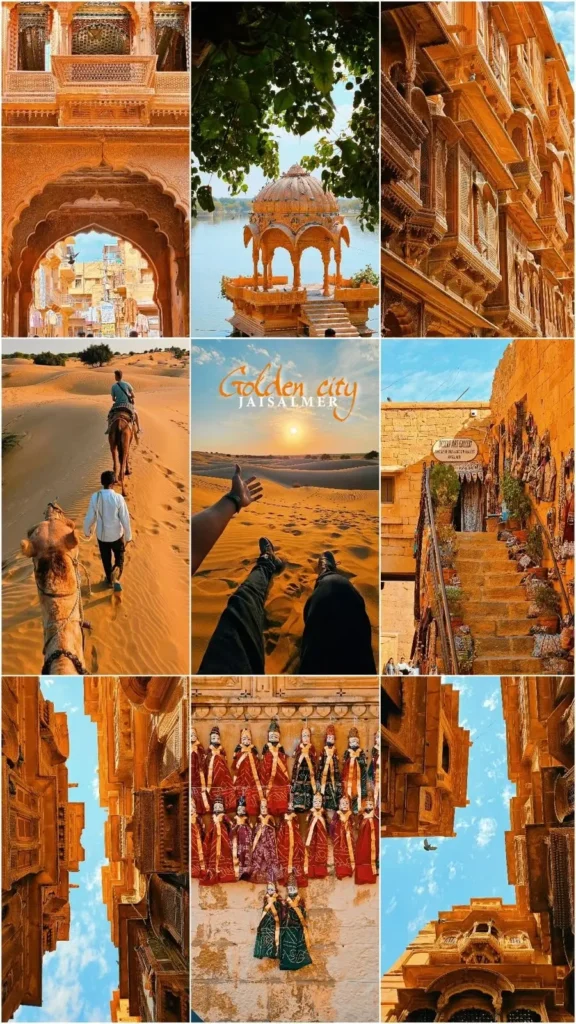
Rising from the flat, tawny expanse of the Thar Desert in western Rajasthan, the Jaisalmer Fort appears from a distance like a vision conjured from the sand itself — a massive sandstone fortress, golden in morning light and amber at dusk, its walls and towers blending so completely with the desert floor that the boundary between the built and the natural is genuinely difficult to locate. This is Sonar Quila — the Golden Fort — a UNESCO World Heritage Site and one of the few living forts in the world, home to thousands of residents, temples, havelis, and restaurants within its 12th-century walls.

Beyond the fort, this itinerary takes the group into the Thar Desert proper — to the Sam Sand Dunes for a camel safari and a night of Rajasthani folk music under an open desert sky, to Kuldhara, an abandoned village whose disappearance in the early 19th century remains one of Rajasthan’s most enduring mysteries, and to the Longewala battlefield and Tanot Mata Temple near the India-Pakistan border — a journey into both military history and an extraordinary legend of faith that has outlasted two wars.
Jaisalmer is not a city that gives itself up easily to those who pass through quickly. This itinerary is built to give you three very different experiences of the Thar — its history, its wilderness, and its border — in a sequence that builds in intensity and ends with the fort itself, which is best understood last, not first.
At a Glance
JAISALMER & LONGEWALA Tour Package (2N/3D)
Spaces are filling up fast for this bucket-list trek.
Book your 2N/3D JAISALMER journey today.
Day 0 — Gurgaon to Jaisalmer | Overnight Journey
AC Tempo Traveller | No Hotel Stay | Travel Night
Board the AC Tempo Traveller at the designated Gurgaon boarding point
Jaisalmer is approximately 800 km from Gurgaon — plan for a 12 to 14 hour overnight drive
Rest, socialise, and let the kilometres pass — the city will announce itself when you arrive
Your trip captain is on board from departure
✦ WravelOn Tip: Carry a neck pillow and a light wrap for the overnight drive. The highway sections after Jodhpur are fast and flat, but the AC can run cold in the small hours.
Day 1 — Jaisalmer Arrival | Sam Sand Dunes | Desert Night
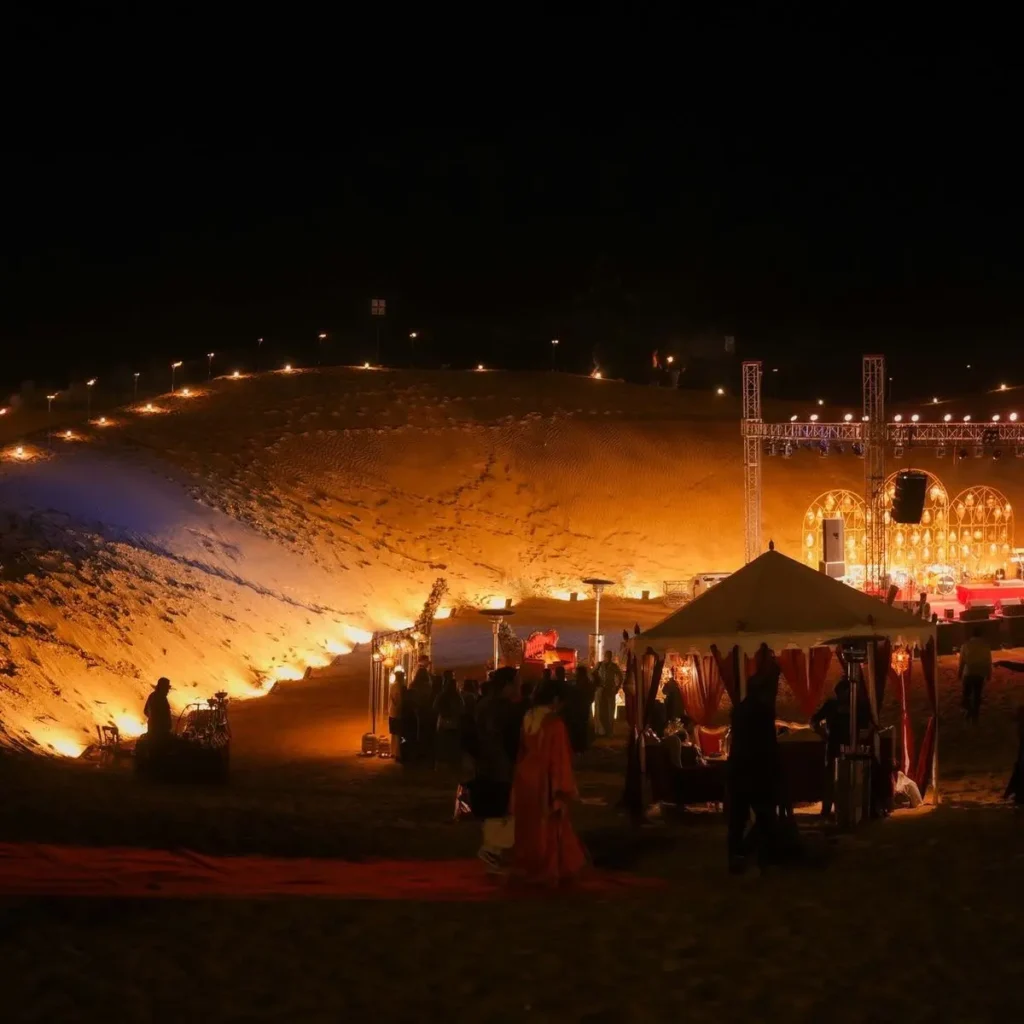
AC Tempo Traveller | Swiss Camp Stay (Sam Sand Dunes) | Dinner
Jaisalmer reveals itself in stages. The land flattens progressively as you drive west through Rajasthan, the vegetation thinning, the air warming, the colours shifting from ochre to gold. The fort appears on the horizon well before you reach it — a rampart of golden stone rising from the desert with an unhurried authority that makes every other fort in Rajasthan look like it is trying too hard.
After arriving, head directly to the Sam Sand Dunes — 42 km west of Jaisalmer city — where the camp is located and where the afternoon is best spent in the desert itself.
Camel Safari — Into the Thar
The Thar Desert is the world’s most densely populated desert — a counterintuitive fact that is less surprising when you stand on the dunes and see the scale and the quiet of the landscape around you. The Sam Sand Dunes are the most dramatic section of the Thar accessible from Jaisalmer — broad, rolling ridges of fine golden sand that reach heights of 30 metres and more, entirely trackless and entirely silent except for the wind.
The camel safari takes the group into the dunes as the afternoon light falls across the sand in long, warm rakes. Camels are the correct mode of transport here — not for nostalgic reasons but practical ones. They move at precisely the right pace for the landscape: slow enough to notice the way the sand changes colour as the sun drops, fast enough to reach the best viewpoints before the light goes. The sunset from the top of a Sam dune, with the silhouettes of the camel caravan against an orange and crimson sky, is one of those images that justifies the entire journey.
Jeep Dune Bashing
After the camel safari, the gear changes entirely — from the measured pace of a camel to the exhilarating physics of a 4×4 being pushed hard across the dunes. Dune bashing in the Sam dunes is a genuinely thrilling experience and a completely different way of understanding the landscape — the contours that a camel navigates slowly become obstacles and ramps to be taken at speed. It is not subtle, but it is very good fun.
Desert Folk Night — Rajasthan Comes Alive
As darkness falls over the desert, the camp comes to life. A bonfire is lit against the cold desert night, and the evening’s cultural programme begins — Rajasthani folk music played on instruments that have accompanied these sands for centuries, Kalbelia dance performed by members of a community whose snake-charmer heritage is inscribed on every movement, and traditional food served in the manner of a Rajasthani household hosting guests.
The Kalbelia community of Rajasthan was inscribed on UNESCO’s list of Intangible Cultural Heritage in 2010 — their dance form, characterised by sinuous, fluid movements that mirror the motion of a cobra, is one of the most hypnotic performance traditions in India. Watching it performed by firelight on a desert night in Jaisalmer is not something that fades quickly from memory.
Evening snacks and Rajasthani dinner included at the camp
Overnight stay in Swiss tents at Sam Sand Dunes
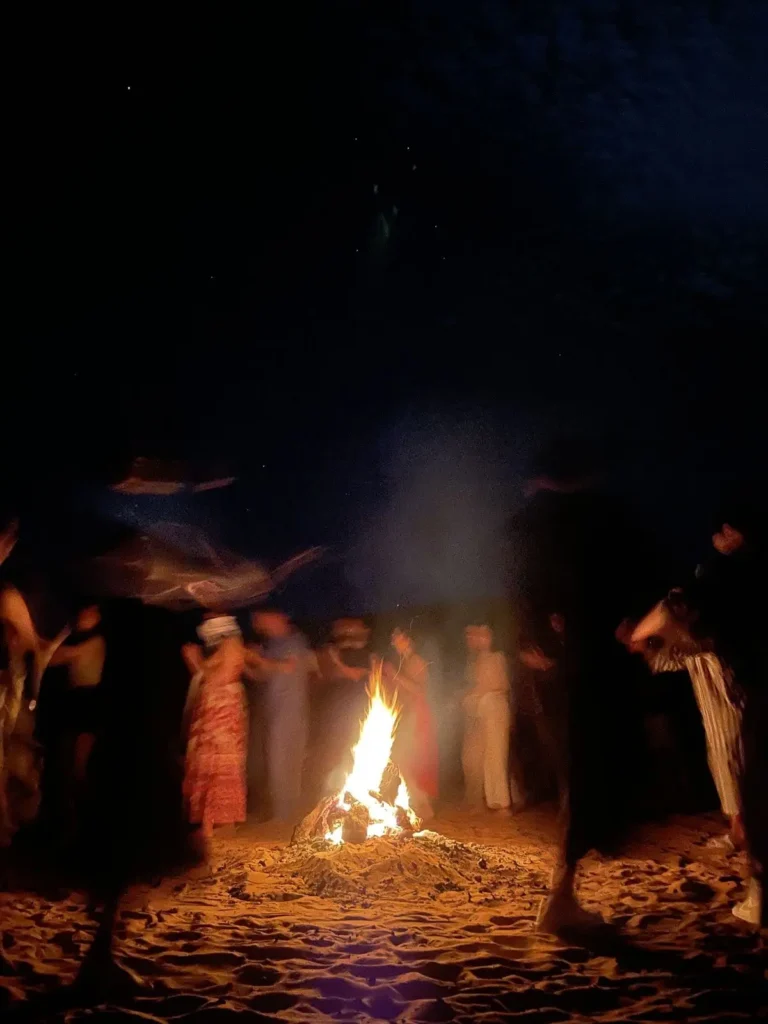
✦ WravelOn Tip: The desert temperature drops significantly after dark — sometimes by 15 to 20 degrees. Carry a warm layer even if you arrive in the heat of the afternoon. You will need it by 9 PM.
Day 2 — Kuldhara | Longewala | Tanot Mata | Second Desert Night

AC Tempo Traveller | Swiss Camp Stay (Sam Sand Dunes) | Breakfast + Evening Snacks + Dinner
The second day moves away from the dunes and into two very different but equally powerful experiences of the desert: an encounter with mystery and history in the abandoned village of Kuldhara, and a journey to the India-Pakistan border that crosses from the spiritual to the patriotic in a way that few trips in India manage.
Kuldhara — The Village That Vanished
Kuldhara sits 18 km from Jaisalmer city, an arrangement of empty sandstone houses, broken walls, and silent streets that has been uninhabited since the early 1800s. The village was founded in the 13th century by the Paliwal Brahmin community — skilled traders and agriculturists who built an intricate network of 84 settlements across western Rajasthan. Kuldhara was the largest and most prosperous of these.
In the early 19th century, the entire community vanished in a single night. Every one of the 84 villages emptied simultaneously, leaving behind only the buildings, a temple, some stepwells, and a legend that has accumulated layers with every passing decade. The most commonly told version attributes the departure to the oppressive demands of the local Diwan Salim Singh, who had his eye on a Paliwal girl. The community, rather than submit, is said to have left under cover of darkness and cursed the land so that no one could settle it again.
No one has. Kuldhara remains uninhabited today. The Archaeological Survey of India maintains the site, which retains its original architecture — carved doorways, the patterns of streets and lanes, a temple still recognisable after two centuries of abandonment. Walking through it in the morning quiet, with the desert on all sides, is one of the more unsettling and genuinely memorable experiences that Jaisalmer offers.
Tanot Mata Temple — Where Faith Held the Line
The drive from Kuldhara to the Tanot Mata Temple covers approximately 120 km of desert highway — a long, straight road through the Thar that eventually narrows as you approach the India-Pakistan border. The landscape grows quieter and more elemental as you drive west. Wind turbines mark the distance on the horizon. Border patrol vehicles appear with increasing frequency. The desert here has a particular quality of silence.
The Tanot Mata Temple was first built in 828 AD by the Bhati Rajput King Tanu Rao and has been a site of worship and pilgrimage in the Thar for over a thousand years. It gained an entirely different order of significance during the Indo-Pakistani Wars of 1965 and 1971. During the 1965 war, the Pakistani Army fired approximately 3,000 shells at and around the temple. According to records and local accounts, none of the shells that fell on the temple compound exploded. The unexploded ordnance was collected by Indian soldiers and is still on display in a museum built by the Border Security Force inside the temple grounds.
In 1971, Pakistani tanks advancing toward Longewala crossed near Tanot. They became bogged down in the sand — a factor that allowed the Indian Air Force to locate and destroy 37 Pakistani tanks in the daylight hours that followed. The BSF, which has administered the temple since 1965, built a Vijay Stambha — a Victory Tower — inside the compound to commemorate the outcome of the Battle of Longewala. Every 16 December, Vijay Diwas, a memorial ceremony is held here.
The temple today is a genuinely moving place — not only for its religious significance but for what it represents about the relationship between faith, landscape, and the people who have lived and fought on this particular stretch of desert for generations.
✦ WravelOn Tip: The temple museum holds the actual unexploded shells from the 1965 war. It is a small but remarkable collection. Take the time to walk through it before or after the main darshan.
Longewala — Where 120 Held Back an Army
A short distance from Tanot Mata lies the Longewala War Memorial — the site of one of the most extraordinary engagements in Indian military history. On the night of 4 December 1971, a Pakistani armoured column of approximately 2,000 soldiers and 45 tanks crossed the border and advanced on the small BSF post at Longewala, defended by just 120 Indian soldiers.
The Indian defenders, lacking anti-tank weapons capable of stopping the column, held their position through the night — buying time for the Indian Air Force to scramble at dawn. When the Hawker Hunter jets arrived at first light on 5 December, the Pakistani
column was exposed on the flat desert floor with no cover. The battle lasted the morning. By the time it ended, 37 Pakistani tanks and over 100 vehicles had been destroyed or abandoned. Pakistani losses in personnel numbered in the hundreds. Indian losses: two soldiers.
The memorial today displays the destroyed Pakistani T-59 tanks, military vehicles, and a Hunter aircraft that participated in the battle — arranged on the desert floor in the approximate positions they occupied during the engagement. The effect is striking in a way that no museum display can quite replicate: the scale of the equipment against the emptiness of the desert, the rust of decades, the silence. A detailed war museum adjacent to the memorial brings context, photographs, and the account of Major Kuldip Singh Chandpuri, who commanded the defence.
✦ WravelOn Tip: The tanks are spread across a wide area and the museum is more substantial than it appears from the entrance. The story deserves to be understood fully before you leave.
- Return to Sam Sand Dunes camp in the evening for another night in the desert
- Evening snacks and dinner included at the camp
- Overnight stay in Swiss tents at Sam Sand Dunes
Day 3 — Jaisalmer City | The Living Fort | Return Journey
AC Tempo Traveller | No Hotel Stay | Breakfast Included | Evening Departure
The final morning is given to the city itself — to Sonar Quila and the streets that surround it. Having spent two days in the desert outside the walls, walking into the fort on the last day carries a different quality of attention. You know something of the landscape it rises from and something of the history that shaped the people who built it.
Jaisalmer Fort — India’s Only Living Fort]
Jaisalmer Fort was built in 1156 AD by Maharawal Jaisal, founder of the city, on the flat-topped Trikuta Hill — a site chosen, according to legend, based on a prophecy by a sage that a descendant of the Yaduvanshi clan would build an impregnable kingdom here. The fort rises 76 metres above the desert plain and encloses an area of approximately 4 km in circumference. Its outer walls are built from the same yellow Jaisalmer limestone as the desert around it — which is why, in the right light, the fort and the landscape appear to be the same continuous substance.
It is one of the few forts in the world that is still fully inhabited. Approximately 3,000 people live within its walls today — a community of shopkeepers, temple priests, restaurateurs, and families whose ancestors built the fort and have never left. Walking inside is not walking through a museum but through a living neighbourhood that happens to be enclosed by 12th-century battlements.
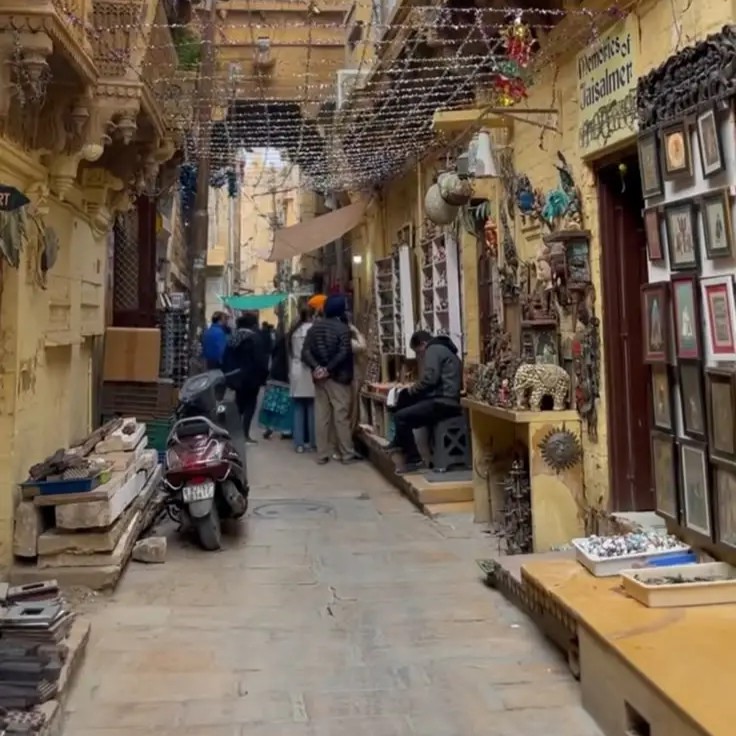
The fort contains four large gateways, a royal palace, seven Jain temples built between the 12th and 15th centuries in a delicate yellow sandstone style that is entirely distinct from the Dilwara marble tradition, numerous ornate havelis, and a network of lanes narrow enough that two people cannot walk side by side in places. The Jain temples inside the fort are particularly remarkable — their carved ceilings and columns are intricate in a way that rewards very slow, very close attention.
Gadisar Lake — Jaisalmer’s Ancient Reservoir
Gadisar Lake was built in the 14th century by Maharawal Gadsi Singh as a water reservoir for the entire city — a critical piece of infrastructure in a desert that receives only 20 cm of rainfall a year. The lake is bordered by small temples and cenotaphs, and entered through a carved gateway arch built by a royal courtesan in the 18th century. The story of the gateway — and the Maharawal’s attempt to demolish it, and the courtesan’s strategic decision to place a Vishnu idol on top so that demolition would be sacrilegious — is one of those Jaisalmer stories that sounds fictional but is not.
The lake is quiet in the morning, the water reflecting the stone arch and the distant fort. It is a good place to spend the last hour before departure — sitting, watching the birds, and letting the city settle in at its own pace.
Patwon Ki Haveli — The Merchant’s Palace
Patwon Ki Haveli is the largest and most elaborately carved of Jaisalmer’s famous havelis — a five-storey mansion built by a wealthy silk and brocade merchant, Guman Chand Patwa, for his five sons in the early 19th century. Each son built his own section of the haveli, which explains both its size and its slightly layered quality. The facade, with its 60-plus jharokhas (overhanging carved balconies), is considered one of the finest examples of Rajput merchant architecture in existence — a building that functioned as both a residence and an advertisement of prosperity in a city that was, at its peak, one of the most important trading posts on the Silk Route.
In the evening, bid farewell to Jaisalmer and board the AC Tempo Traveller for the overnight return journey to Gurgaon
Arrive Gurgaon the following morning — with the desert still in your lungs and sand, in all probability, still in your shoes
Inclusions
Travel
- AC Tempo Traveller throughout — Gurgaon to Gurgaon, all days
- Local transfers within Jaisalmer and to/from Sam Sand Dunes, Kuldhara, Tanot Mata, Longewala
- Driver allowances, toll taxes, parking and state road taxes
Stay
2 nights in Swiss tents at Sam Sand Dunes
Meals
- Evening snacks x2 (Day 1 and Day 2 at the desert camp)
- Rajasthani dinner x2 (Day 1 and Day 2 at the desert camp)
- Breakfast x1 (Day 3 at the desert camp before check-out)
- Rajasthani folk dinner on one night during the stay
Activities & Entertainment
- Camel safari in the Thar Desert at Sam Sand Dunes
- Jeep dune bashing at Sam Sand Dunes
- Rajasthani folk show with Kalbelia dance, live music, and bonfire on both camp nights
Other
An experienced WravelOn trip captain for the full duration
Exclusions
- Round-trip flights or train tickets to and from the starting point.
- Entry fees to Jaisalmer Fort Museum, Patwon Ki Haveli, and other ticketed attractions inside the city
- Any meals not listed under Inclusions — all lunches and any dinners outside the camp
- Personal expenses — shopping, laundry, tips, or any spending of a personal nature
- Any photography or video shoot fees at restricted locations near the border area
- Any cost arising from itinerary deviations, natural delays, or services not listed above
What to Carry
Clothing
- Light cotton clothing for daytime — desert days are warm even in cooler months
- A warm jacket and thermal layer for desert nights — the temperature drops sharply after sunset in the Thar
- Comfortable, closed-toe shoes for fort walking and the Kuldhara site — sandals are not practical on uneven desert terrain
- A scarf or buff for the camel safari — the dune wind carries fine sand
- Sunglasses and a wide-brim sun hat — direct desert sun is intense at any altitude
Essentials
- Valid government ID — original plus photocopy, in separate waterproof sleeves
- Sunscreen SPF 50+ — apply generously and reapply during camel safari and dune bashing
- Cash — the camp, camel handlers, and local vendors around Kuldhara and Tanot operate on cash
- Power bank — camp charging facilities are limited
- Personal medications and a basic first aid kit
How to Reach the Starting Point
The trip departs from Gurgaon. The designated boarding point will be confirmed before departure — typically IFFCO Chowk Metro Station or a nearby landmark.
By Metro: Yellow Line to IFFCO Chowk
By Road: Gurgaon is well connected from Delhi, Noida, and Faridabad — allow buffer time for traffic
Important Guidelines
Kuldhara — the site is maintained by the Archaeological Survey of India. No climbing on or damaging of the ruins. Stay on marked paths where indicated
Tanot Mata Temple and Longewala — these sites are managed by the BSF and Indian Army. Follow all instructions from personnel on site. Photography may be restricted in certain areas near the border — always ask before photographing
Camel safari — inform the trip captain of any physical conditions that may affect your ability to ride before the activity begins
⚠ Note: The road from Jaisalmer to Tanot Mata is approximately 120 km and takes 2 hours each way through remote desert terrain. Carry sufficient water for the drive — roadside facilities are minimal between Jaisalmer and the temple.


Cancellation Policy
By confirming a booking with WravelOn, you agree to the following terms.
Booking & Payments
- All advances and deposits are non-refundable and interest-free
- Full amount forfeited in case of no-shows, late cancellations, or early exit from the trip
- No refunds for unused meals, transport, or activities
- Promotional bookings are non-refundable from the moment of confirmation
Group Size & Batch Operations
A minimum group size is required for independent batch operation
If the minimum is not met, WravelOn may merge with a verified local operator
Force Majeure
WravelOn is not responsible for delays from government orders, extreme weather, or events beyond its control
Trips cancelled before departure due to natural calamities will result in a travel voucher valid for 365 days, not a cash refund
Liability
Guests are responsible for their own luggage and valuables throughout
WravelOn acts as a facilitator for third-party services and is not liable for disruptions from hotels, camps, or transport providers